

Twenty years of these conversations produce the same shape. If you recognise your own organisation in the first two, the rest of the page is worth reading.

Customer stories
What it looks like
from their side
Every organisation on this page had the same problem before they rang us: a date that could not move and a list that was not finished. These are their accounts of what happened next, including the parts that were annoying.
•
Named organisations
•
Approved before publishing
•
Including what went wrong
25,000+
Products available
4,000+
Organisations served
40+
Years, since 1984
4.9★
From 2,300+ reviews
What they have in common
The same five things, every time
01
It started with a date, not a product
Nobody rings a trophy supplier because they want trophies. They ring because a presentation night, speech night or annual awards is booked and the awards are the last thing left.
Where they were: a fixed date, an unfinished list
02
The list was the hard part
Not the choosing. Names in three formats, late additions, a grade nobody could confirm, and one person holding all of it in an inbox.
Where they were: one spreadsheet, four versions
03
The old arrangement had drifted
Different supplier each year, or the same supplier and a different range, so nothing matched what was in the cabinet from three years ago.
Where they were: no record anyone held
04
Someone read the proof properly
This is the step that separates the smooth years from the bad ones, and it is the step organisations skip when they are behind.
What changed: one nominated approver
05
The second year was easier than the first
Sizes, artwork and layout on file; the reminder came to them. This is the part nobody asks about at quote stage and everybody notices twelve months later.
What changed: the record moved to us
Who we work with
Four kinds of awards problem
Different organisations, the same handful of situations. Most people reading this page are in one of these four rows.
Client types and what they need
Organisation
Typical order
The hard part
What usually fixes it
Sporting club
A trophy for every player, plus graded awards
Numbers move until the last week
Order on known numbers, hold the plates
School
Year-level awards, subject prizes, honour boards
Results land late, board must match
Plates cut late, layout held on file
Business
Quarterly and annual recognition awards
Consistency across sites and years
One design, held, reordered
Council or association
Service awards, civic recognition, life membership
Formality and correct titles
Proof approved by the right person
If none of these is you, the conversation is still fifteen minutes — it is the fastest way to find out whether we are the right supplier for what you are doing.
How a rollout runs
The pattern behind every story here
01
One call, then a shortlist
Numbers, roles and the date. We come back with a set rather than a catalogue, because a catalogue is what stalled them last year.
02
The list, in one file
One version, one approver. Almost every problem in these stories traces back to a second version of the list existing somewhere.
03
Proof, then production
Nothing is engraved until it is signed off. Spelling is permanent and a proof is the last point at which it is free.
04
Then it is on file
Artwork, sizes, layout and winner history stay with us, which is why the second year takes a fraction of the time.
The whole process, written down
Stage by stage, with what we need from you at each one.
PRESENTATION NIGHT PLANNING

How these are written
Interviewed, sourced, approved
01
A conversation, then a draft
We record a conversation with the person who actually ran the awards, then write it up and send the whole thing back to read.
02
Figures come from their records
Anything about their organisation comes from their numbers, not our estimate. A figure we cannot attribute does not appear.
03
They approve it in writing
Dated approval of the final text and of the use of their name, before anything is published. A verbal yes is not enough.
04
Anonymous is fine
Plenty of organisations will describe everything and not put their name to it — usually policy, not reticence. Those publish as a sector, a state and a size, marked as anonymous.
05
It comes down on request
Same day, no discussion. Approval to publish is not permanent consent.
Nothing is offered in exchange
No discount, no free order, nothing conditional on what is said. A story with an incentive behind it would have to be disclosed as one, which would make it worthless.

The stories
Six organisations, six situations
Sorted by the situation rather than the sector — a three-site dental group and a junior football club have more in common than either does with the school next door.
Written examples · not publishable until interviewed, sourced and approved
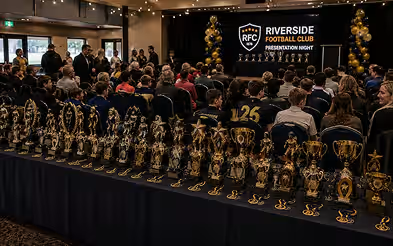
Sporting club · 140 players
Every player, one night
Six teams, one presentation, and a list that grew by eleven names in the fortnight before it.

Secondary school · Years 7–12
Results that landed late
Plates cut four days out, fitted the morning of speech night, matching a board started in 1974.

Business · four sites
The same award, everywhere
A quarterly program that had drifted into four different awards in four states.

Association · since 1952
The cup nobody could find
Two missing years, a trophy in a former president’s garage, and a history rebuilt from photographs.
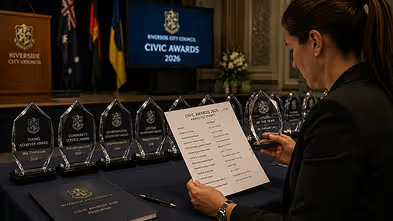
Council · civic awards
Titles that had to be right
Formal citations, correct honorifics, and a proof read by three people before anything was cut.

Sporting club · the one we got wrong
Late, and how we fixed it
A back-ordered style arrived a week late into a club that had already printed the run sheet. Published because the recovery is the useful part.
Good to know
About these stories
Who writes them?
We do, from a recorded conversation and from order records. The client then reads the whole thing and approves it in writing. Nothing is published on the strength of a verbal yes.
Are the figures checked?
They are sourced rather than audited. Anything about the client’s organisation comes from their records and is checked back with them; anything about the order comes from ours. A number we cannot attribute does not go in.
Do clients get anything for taking part?
No. Nothing is offered in exchange and nothing published is conditional on what is said.
Why publish one where you got it wrong?
Because how a supplier handles a bad week tells you more than how they handle the good ones. The late-delivery story is on this page for that reason and it stays there.
Can we take part?
If you have been through a changeover, someone reading this page is about to. It is roughly two hours of your time in total, you approve the final text, and anonymous is fine.
Can a story be removed later?
Yes, the same day and without a discussion.
Next
Where people go from here
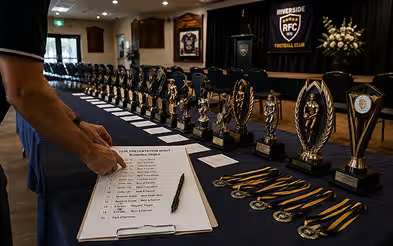
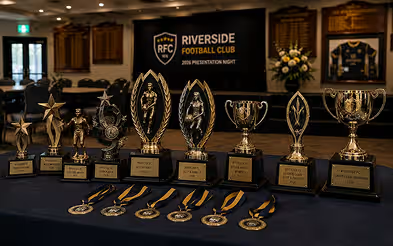
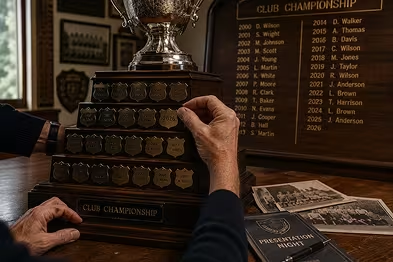
Australian trophy makers since 1984
Tell us what you are up against
Fifteen minutes on the phone will tell you more than this page can — what your set would look like, roughly what it costs, and whether we are the right supplier for your night.