

A better trophy cannot rescue a vague award. Decide what happened, who earned recognition and how important the moment is before you decide what to buy.

Recognition guide
Recognise them
for what mattered
The award is only the object. Recognition is the reason it is being handed over, the words said with it and whether the recipient believes they earned it. Start with the achievement, then choose an award that gives that achievement the right weight.
40+
Years, since 1984
4,000+
Organisations served
25,000+
Products available
4.9★
From 2,300+ reviews
Start before the product
Five decisions make recognition mean something
The five decisionsRecognition levelsBy occasionChoose the awardWrite the wordsPresent it wellRepeat programsQuestions
01
What exactly are you recognising?
Name the achievement in plain language. Winning, improving, serving, leading and volunteering are different achievements and should not all produce the same award.
Settle first: the reason, in one sentence
02
Who has genuinely earned it?
Decide whether the award is based on results, contribution, improvement, service, values, participation or a milestone. Clear criteria make recognition feel earned.
Settle first: eligibility and selection
03
How significant is the moment?
A participation medal and a lifetime-service award should not carry the same visual weight. Let scale, material and permanence rise with significance.
Settle first: everyday, major or legacy
04
What should the recipient remember?
Years later, the recipient should still be able to tell what they did, where they did it and when. The inscription and presentation preserve that story.
Settle first: the story to preserve
05
Is this one moment or a program?
Annual and seasonal recognition needs repeatable categories, artwork, records and previous-winner history so the next presentation does not start from zero.
Settle first: one-off or repeatable
Recognition hierarchy
Match the award to the weight of the achievement
People should be able to see and feel the difference between taking part, standing out, winning and leaving a legacy.
Level 01
Participation & belonging
Taking part, completing a season or program, or contributing as part of a group.
Level 02
Progress & contribution
Improvement, effort, sportsmanship, citizenship, teamwork, values or consistent contribution.
Level 03
Excellence & achievement
Winners, top performers, academic excellence, leadership and standout performance.
Level 04
Legacy & service
Long service, life membership, dux, club champion and recurring major awards.
The rule
Use consistency within each level, then make the step between levels visible. If every award is equally large and equally premium, the hierarchy disappears.
Recognition by occasion
The reason changes. The principle does not.
Good recognition tells people what mattered. Each setting has its own categories, but the achievement should always be specific and the award should fit the moment.

Sport

School

Workplace

Community

Service
Setting
Common reasons
Typical hierarchy
Sport
Participation, placing, best & fairest, most improved, premiership, club champion, coaching, volunteering
Participation → category award → major winner → perpetual / life membership
School
Academic excellence, improvement, citizenship, leadership, graduation, sport, staff service
Participation → subject/category → major academic or leadership → dux / legacy
Workplace
Sales, performance, values, innovation, leadership, service, retirement, team contribution
Contribution → annual category → major achievement → long service / legacy
Community
Volunteer contribution, committee service, community impact, milestones, lifetime contribution
Contribution → service award → major impact → life membership
Choosing the object
Choose what the award has to do
Material and size should follow the recognition brief. Start with where it will be presented, whether it will be kept or updated, how much wording it needs and how clearly it must read from the room.
Award format
Best suited to
What it communicates
Medal or ribbon
Participation, placing, carnivals
Accessible, consistent group recognition
Trophy
Sport, school, competitions
A clear personal achievement
Cup
Championships and major winners
Traditional status and hierarchy
Plaque or shield
Service, leadership, perpetual recognition
Permanence and history
Crystal, glass or acrylic
Corporate and premium recognition
Formal, contemporary presentation
Honour board / perpetual
Recurring major awards
A record that grows in value over time

Make it specific
The words turn an
object into their award
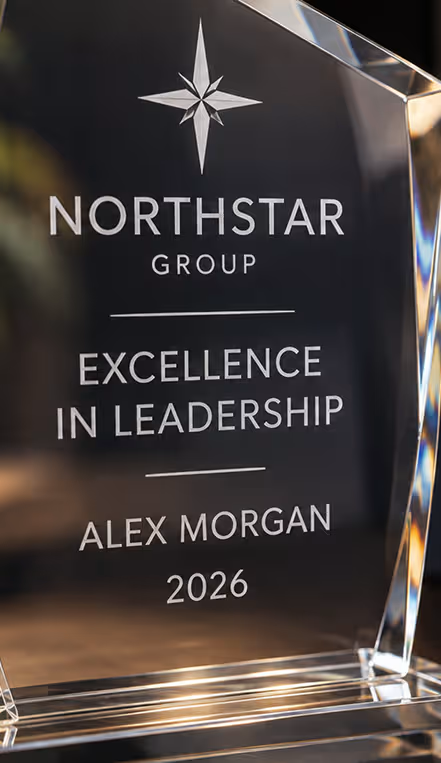
A generic inscription says what the trophy is. A good inscription says why this person is holding it.
01
Organisation or event
Use it where context is not already obvious from the logo or award design.
02
Award title
Make the category specific: Most Improved, Academic Excellence, 20 Years of Service, Club Champion.
03
Recipient
The person or team is usually the most important line and should read that way.
04
Achievement and year
Add the result, grade, season or year where it helps the award tell its story later.
Keep the front readable
Do not force a speech onto an engraving plate. Put the essential recognition on the award and use the presentation citation, card or letter for the longer story.
The handover
Recognition is heard before it is displayed
The presentation tells the room why this person matters. Give the award context instead of reading the engraving aloud and moving on.
01
Name the achievement
Say clearly what is being recognised. Avoid vague introductions such as “for everything you do”.
02
Give the evidence
One concrete result, behaviour, improvement or act of service makes recognition credible.
03
Explain why it mattered
Connect the achievement to the team, school, club, organisation or community it affected.
04
Give them the moment
Say their name, pause, present the award properly and let the room respond.

Annual & recurring awards
Build a recognition system,
not another spreadsheet
If recognition happens every season or every year, the process should become easier and more consistent each time.
Keep consistent
The program
Award categories and hierarchy, approved award family, organisation artwork, engraving format, naming conventions and perpetual layouts.
Update each cycle
The recipients
Names, year or season, placings, achievement details, new categories and previous-winner records.
Why this matters
Consistency makes the program look intentional, reduces proofing errors and makes future ordering faster without making every recipient’s achievement feel the same.

Good to know
Recognition questions
Should everyone receive an award?
Participation recognition can be appropriate where taking part or completing the program is itself the achievement. It should remain distinct from awards for improvement, contribution, excellence or winning so each level keeps its meaning.
How many award categories should we have?
Enough to recognise the achievements your organisation genuinely values, but not so many that categories are invented simply to distribute more awards. Start with the behaviours, results and milestones you want to recognise, then build the category list.
Should major awards look different?
Usually, yes. A visible hierarchy helps the room understand the relative significance of participation, category achievement, major winners and legacy recognition.
What should be engraved?
Usually the organisation or event where needed, award title, recipient, achievement or category, and year. Keep only what adds meaning and remains readable.
What makes recognition feel genuine?
Specificity. Name what the person did, give a concrete example and explain why it mattered. The award then becomes a permanent reminder of a credible moment rather than a generic object.
How should annual awards be managed?
Keep categories, artwork, product families, engraving formats and perpetual records consistent. Update recipient data each cycle and retain approved files so future ordering starts from a known system.
Go deeper
Recognition by setting
The same principles apply everywhere, but the categories, award hierarchy and presentation requirements change by audience.
Need help building the program?
Tell us what you need to recognise.
Give us the occasion, recipient numbers, award levels and timing. We can help turn that into a consistent range of awards and a repeatable ordering process.